

0
vulnerabilities catalogued in the public record
Source: NVD. Placeholder, replace before launch
Cybersecurity platform
CloudKey monitors your attack surface continuously and tells your team what to fix first. Every finding is backed by evidence, not noise.
The problem
0
vulnerabilities catalogued in the public record
Source: NVD. Placeholder, replace before launch
0
carry confirmed evidence of active exploitation
Source: CISA KEV. Placeholder, replace before launch
0
vendor advisories published every year
Source: vendor advisories. Placeholder, replace before launch
Our approach
Six rules behind every CloudKey output. Scroll through them, or jump.
Services and products
See what's exposed outside and inside, verify what works, control what's privileged, with evidence on every finding.
Layer 01 . Visibility
DarkWeb Report shows the view an attacker has of your domain. VulnMonitor reconciles every advisory against the equipment you actually run.
Layer 02 . Verification
Security Audit measures posture against CIS Benchmarks. Penetration testing runs adversarial scenarios, external and internal scope, RoE-gated, with re-test included.
Layer 03 . Control
PAM vaults privileged credentials, records every session, and gives auditors a full trace of who touched which server and when.
01 . Visibility, external
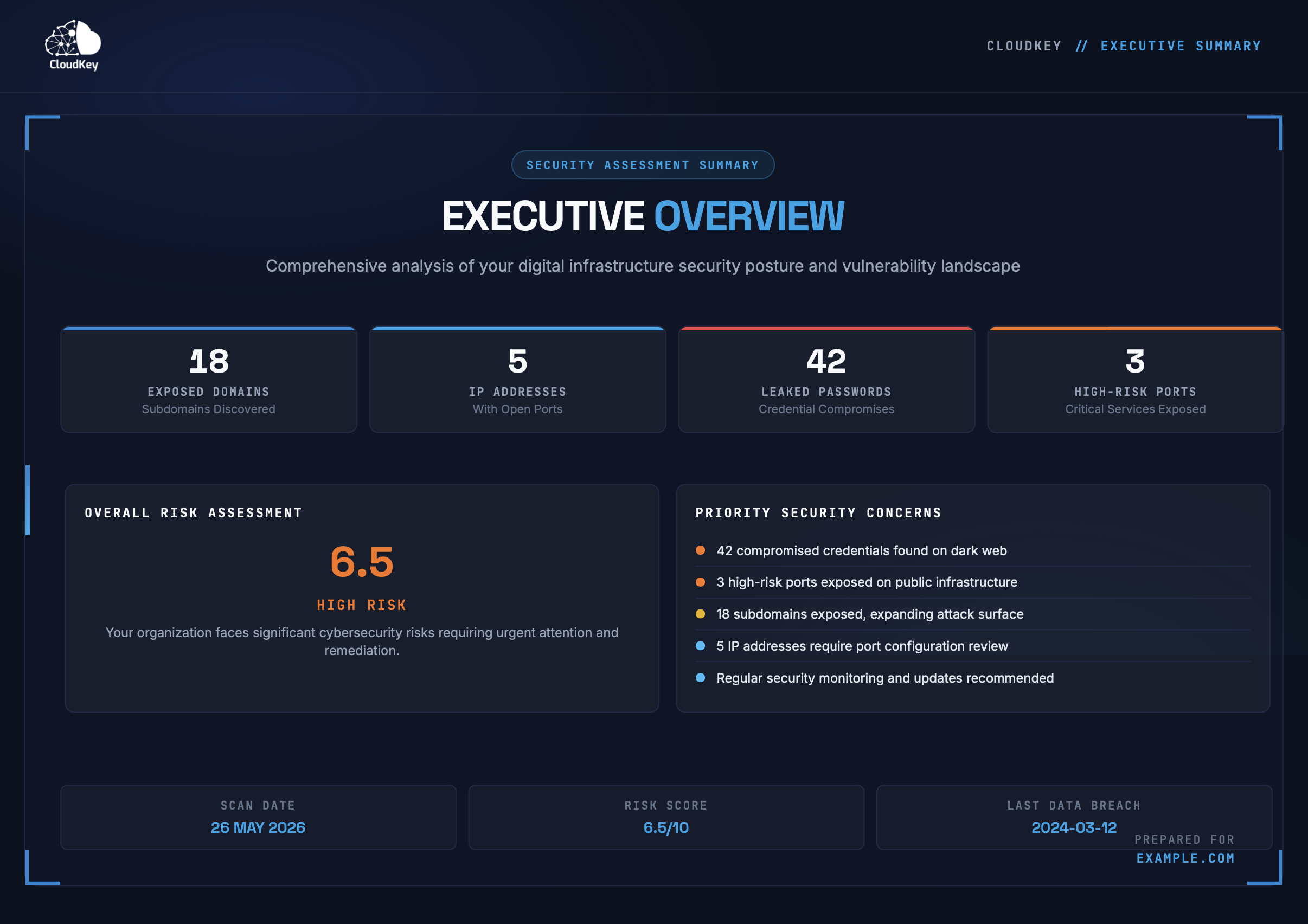
The view an attacker has of your business. A monthly scan of your domain pulls leaked credentials from breach corpora, exposed subdomains, open ports on internet-facing IPs and vulnerabilities on edge services, ranked into one executive risk score.
02 . Visibility, internal
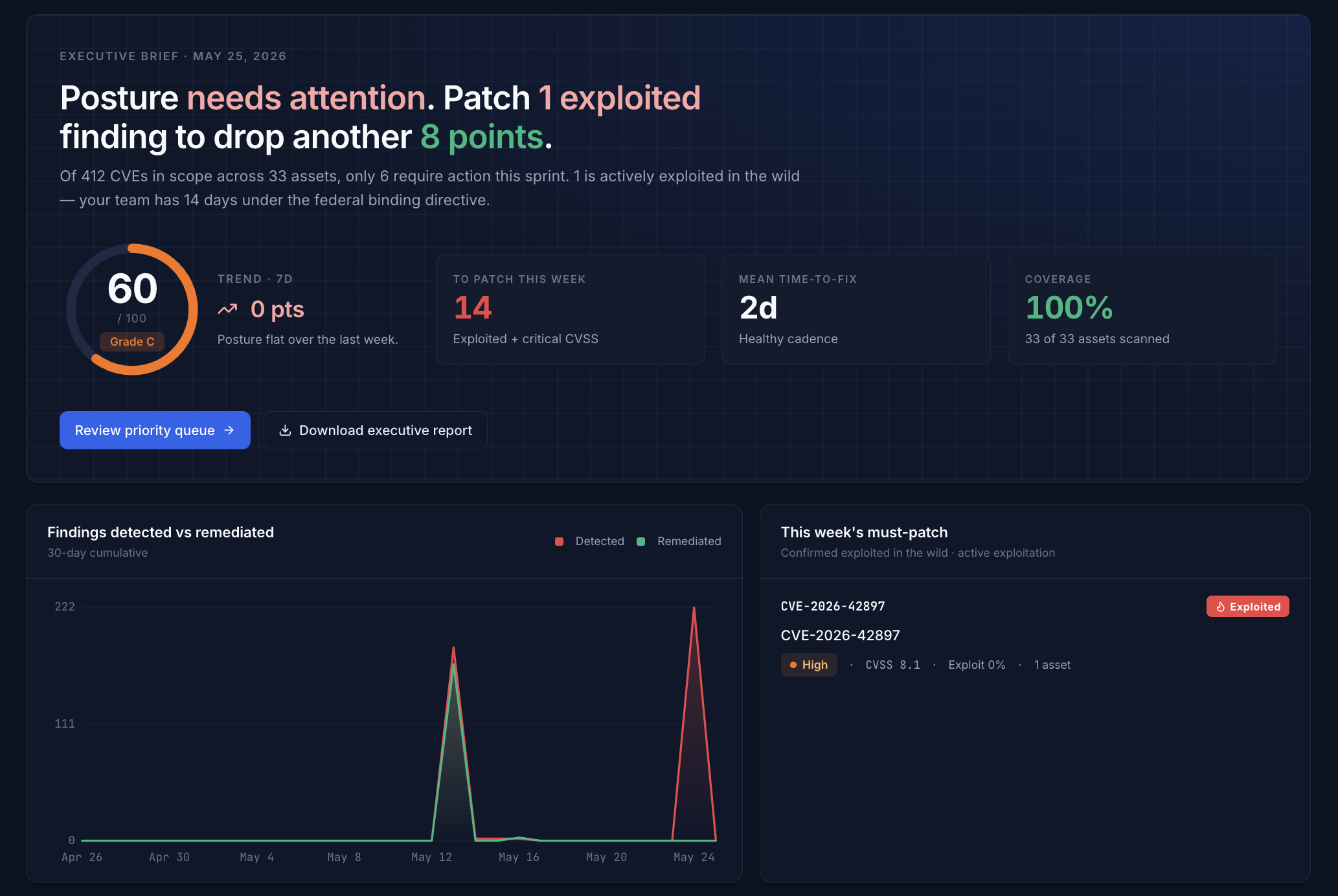
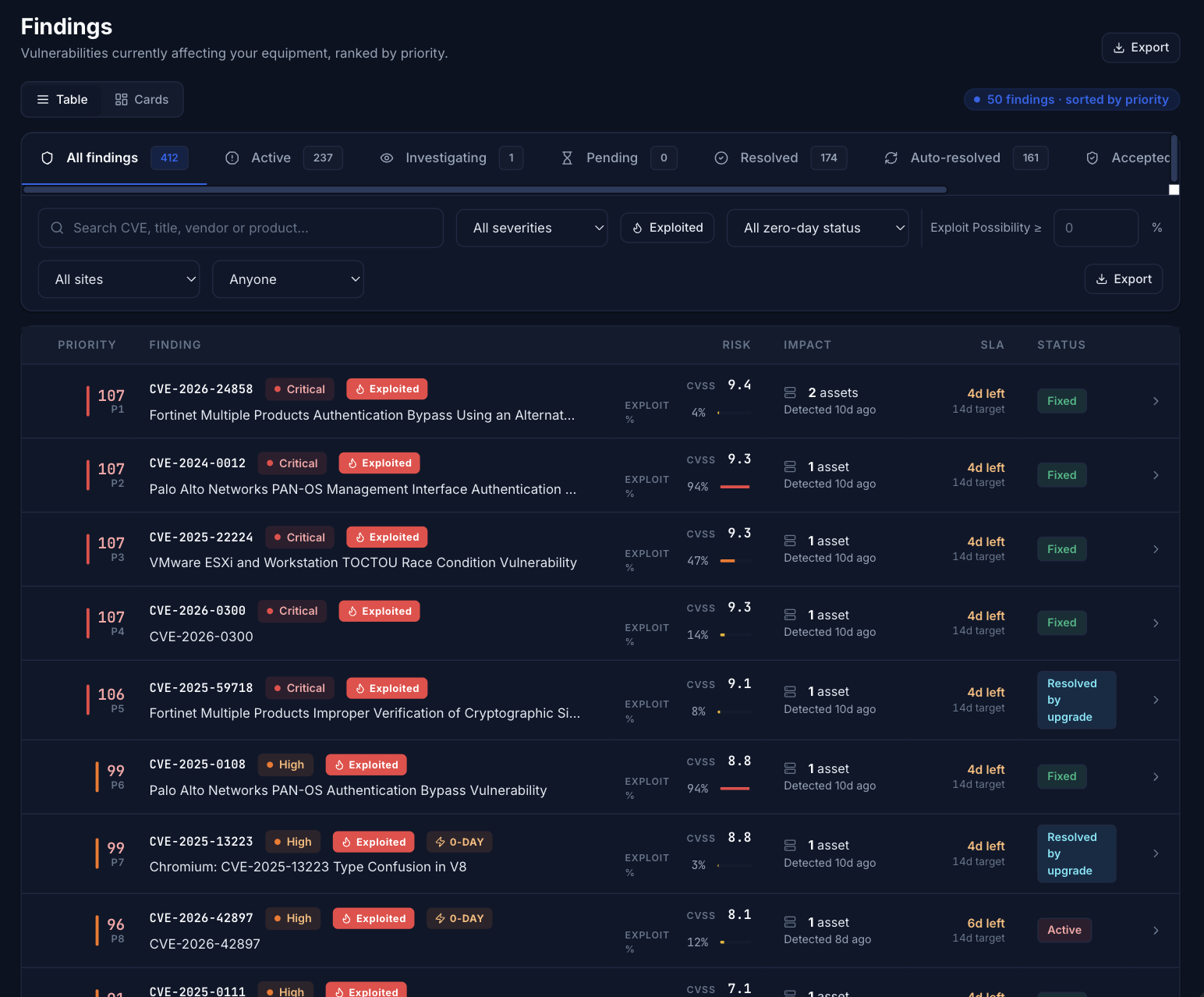
The view from inside your perimeter. VulnMonitor reconciles every advisory against your real equipment inventory, servers, network gear, endpoints, applications, and surfaces zero-day exposure the moment an advisory drops, not when the CVE lands days later.
03 . Verification, posture
A structured review of your production systems against CIS Benchmarks, every gap documented, owned by a named person, and given a remediation estimate.
04 . Verification, adversarial
Scoped, authorized testing of your web apps, APIs and network, external and internal scope. Every engagement opens with a signed Rules of Engagement and closes with reproducible, prioritized findings.
05 . Control, privileged access
Vault privileged credentials, record every privileged session, and grant access just-in-time, with a full trace of who touched which server and when, mapped to the controls your ISO 27001 and SOC 2 auditors read.
By the numbers
Security is not one chart. Each number below is the kind of risk one of our services is built to close.
01 . External exposure
0 B+
Credentials sitting in public breach corpora today.
If staff reuse passwords, this is the first well attackers draw from. DarkWeb Report cross-checks your domains against breach databases every month and flags the hits before they become an incident.
DarkWeb ReportSource: aggregate breach corpus counts (Have I Been Pwned and similar). Placeholder, replace before launch
02 . CVE volume
0 +/yr
New vulnerabilities published every year.
About 110 advisories hit the NVD catalog daily. VulnMonitor reconciles each one against the gear you actually run, then ranks the few that matter against KEV and EPSS.
VulnMonitorSource: NVD 2024 CVE feed. Placeholder, replace before launch
03 . Time to detect
0 days
Median time to identify a breach.
Posture reviews and adversarial testing shorten this number. Security Audit measures your stack against CIS Benchmarks. Penetration testing proves the controls hold under attack, then re-tests every fix.
Security Audit + PentestSource: IBM Cost of a Data Breach Report 2024. Placeholder, replace before launch
04 . Compromised credentials
0 %
Of breaches involve compromised or stolen credentials.
Privileged accounts are the keys to the kingdom. PAM vaults them, records every session, and gives auditors a full trace of who touched which server and when.
PAMSource: Verizon Data Breach Investigations Report 2024. Placeholder, replace before launch
CloudKey covers the full chain. See what's exposed, prove your defenses hold, lock down privileged access. Three layers, evidence on every finding.
Book a platform demoResources
 New
New Methodology
What CISA's exploit-evidence list tells you about patch order, illustrated with two real CVEs from this month.
Read Field notes
We take a redacted monthly report and walk through it section by section. The open-finding ledger. The re-test attestations. The bits people actually argue about.
Read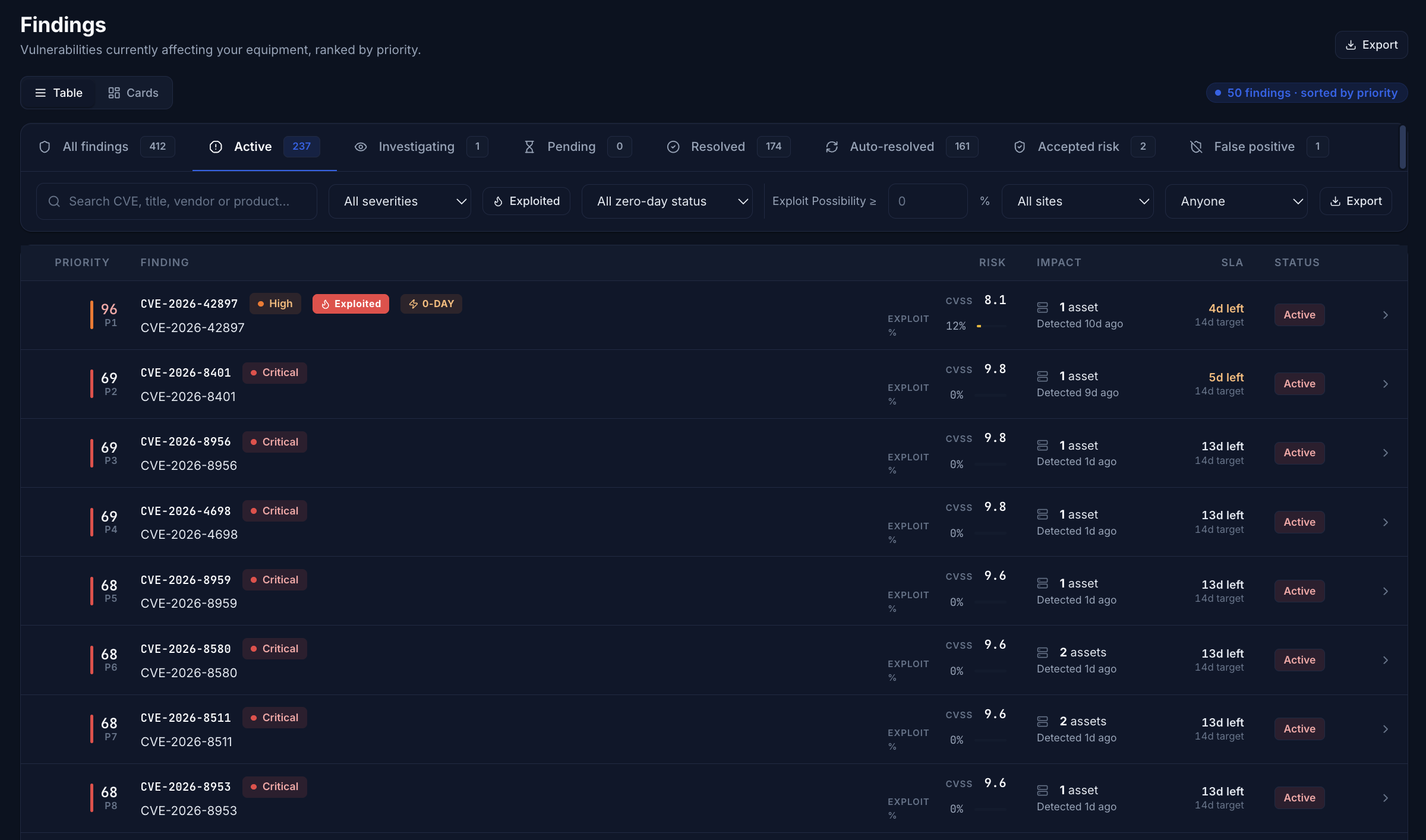
Engineering
What your team thinks is in production is rarely exactly what the package manifests say. This is how CloudKey reconciles the drift.
ReadStart with visibility
One redacted report a month: leaked credentials, exposed subdomains, edge vulnerabilities, scoped to the domains you authorize, delivered to a named owner. Verification and Control layers follow once the picture is clear.
Reconnaissance only runs after written authorization. Our scope policy. →